
Mr Speaker’s Intro!
Crude oil plays a crucial role in determining global oil prices because it is the primary input in the petroleum value chain.
Before you talk about oil refining, crude must first be sourced, and its availability and cost directly impact oil pump prices and the refined products.
Let me be honest with you, as it stands today, Nigeria allocates only about 20% of its crude oil to local refining because our crude oil has always been used as collateral for international loans for a long time.
As a result, we remain heavily indebted as a country, and a significant barrel of crude is already committed to servicing these debts.
Now that Dangote Refinery is currently acting as the dominant buyer and processor of our crude for local consumption, it holds considerable influence over pricing in the domestic market.
As a private business, its pricing decisions are guided by profit considerations, which places the country in a delicate position at the moment.
Also, the involvement of middlemen in the distribution chain further contributes to the price variations we experience.
For example, Dangote sells directly to the major marketers such as MRS, Total, Conoil, OPTIMA, etc., just to mention a few, as against the former practice where independent marketers could buy directly from the depot.
These are the reasons why we are experiencing a spike in the price of petroleum products today.

Question
Nigerians have been battling persistently high petrol pump prices in recent weeks, largely driven by the surge in global oil prices following the US/Israel–Iran war.
Yes, global oil prices fluctuate daily, just like exchange rates, and both directly impact local petrol prices.
But here’s the question:
Why do Nigerian oil marketers adjust pump prices almost immediately when global oil prices rise, yet fail to respond with the same speed when prices fall?
Answer
Oil marketers operate as profit-driven businesses, and their pricing behaviour reflects this reality.
When global oil prices rise, they anticipate higher replacement costs for their products and adjust pump prices accordingly to avoid losses when restocking at higher rates.
Question
Ok sir, are you saying the price is adjusted from the major dealers?
Answer
The current system requires independent marketers to source products through major marketers, unlike the earlier arrangement where they could buy directly from depots.
This shift has increased dependence on a few dominant players, effectively turning them into intermediaries and placing smaller marketers at their mercy.
Question
Ok, I think the industry is not well-regulated as there’s no price control.
Onto the next question.
The Dangote Refinery has the capacity to process 650,000 barrels of crude oil per day.
Meanwhile, Nigeria’s daily petrol consumption is about 327,000 barrels (approximately 52 million litres).
Therefore, the refinery has the capacity to meet 100% of Nigeria’s local demand.
So, why are we still importing crude, which definitely contributes to high petrol pump prices?
Answer
Only about 20% of Nigeria’s crude oil production is allocated to Dangote Refinery like I said, meaning the refinery must source the remaining supply from the international market.
This reliance on foreign crude exposes it to global pricing and foreign exchange fluctuations.
Question
What could be the reason(s) for this?
Answer
The primary reason is that a substantial portion of Nigeria’s crude oil has been tied to loan agreements by previous administrations, a practice that continues today.
These crude-backed loans reduce the volume available for domestic refining.
Question
Ex-president Muhammadu Buhari, upon resuming office, cancelled some existing crude-for-refined-product swap contracts inherited from the previous administration with the intent of addressing corruption and inefficiencies in the oil sector, but later continued with crude-backed loans.
Don’t you think President Tinubu should use force majeure on about $8 billion crude-backed loans taken during the previous administration so Dangote Refinery can have adequate crude to refine for local consumption?
Perhaps, Nigeria produces not less than 1.5 million barrels of crude oil daily, and the crude-backed loans taken during Buhari’s administration are paid back with 30,000 barrels of crude daily.
Answer
Available information suggests that a significant share of Nigeria’s crude oil has already been committed under long-term international agreements tied to loans.
In some cases, these commitments span decades, meaning that even future production, up to 50 years, has effectively been pre-allocated.
Question
This is heartbreaking, but I think the daily payback in crude equivalent shouldn’t affect our supply for local refining of crude oil.
Answer
Nigeria produces not less than 1.5 million barrels of crude oil daily. However, due to existing obligations and inefficiencies, only a limited portion of this production is available for domestic refining.
For as long as Dangote remains in business to make a return on its multi-billion-dollar refinery investment, we can only hope for the best outcomes for Nigerians.
Refineries, including Dangote Refinery, buy crude oil at global benchmark prices, often in dollars, even when sourced locally. That naturally increases production costs.
Question
If the Nigerian government is benefiting from high global oil prices, why can’t it temporarily reintroduce subsidies during this crisis or sell crude to Dangote Refinery at a controlled, benchmarked rate until the situation stabilizes?
Again, why can’t we have strategic petroleum reserves to absorb shocks in times like this?
Answer
The challenges facing local refineries go beyond funding and infrastructure.
There are deep-rooted issues within the system, including inefficiencies and alleged sabotage by some actors within the sector, which have historically hindered optimal refinery operations.
Question
I mean, why can’t the government reintroduce subsidies or sell crude to Dangote at a controlled price for the meantime so the government can control pump prices a bit?
Answer
No government is likely to willingly reintroduce fuel subsidies, regardless of short-term benefits.
Subsidies have historically been associated with fiscal strain, corruption, and inefficiencies, making them an unsustainable solution in the long run.
Question
What about having petroleum reserves?
Many oil-producing countries have them.
Answer
The establishment and effective management of petroleum reserves depend largely on administrative efficiency and institutional discipline.
Without proper oversight, such reserves may fail to serve their intended purpose.
Fuel subsidy has long been criticized as a system that enables corruption and enriches a few individuals.
While its removal has created economic hardship, many believe it remains a necessary step toward reforming the oil and gas sector.
Question
Petrol prices have risen globally, from Africa to Europe, America, and Asia.
However, Nigeria feels the impact more severely. Why do we suffer more?
Answer
That remains a critical question. If the appropriate policies, structures, and accountability mechanisms were in place, Nigeria might not find itself in the current situation.
Question
Petrol is not just used for transportation; it powers generators in homes, businesses, and industries due to the country’s weak electricity supply.
Here’s a serious question:
Is the harsh impact of high petrol prices in Nigeria largely a failure of governance, especially in the power sector?
Answer
Yes, to a large extent, it reflects governance challenges.
The country’s heavy reliance on petrol for power generation due to inadequate electricity supply has heightened the impact of rising fuel prices on citizens. Yeah, I totally agree with that.
Question
A comparison of pre-war and current petrol prices across African countries shows that Nigeria’s percentage increase is higher than in many others.
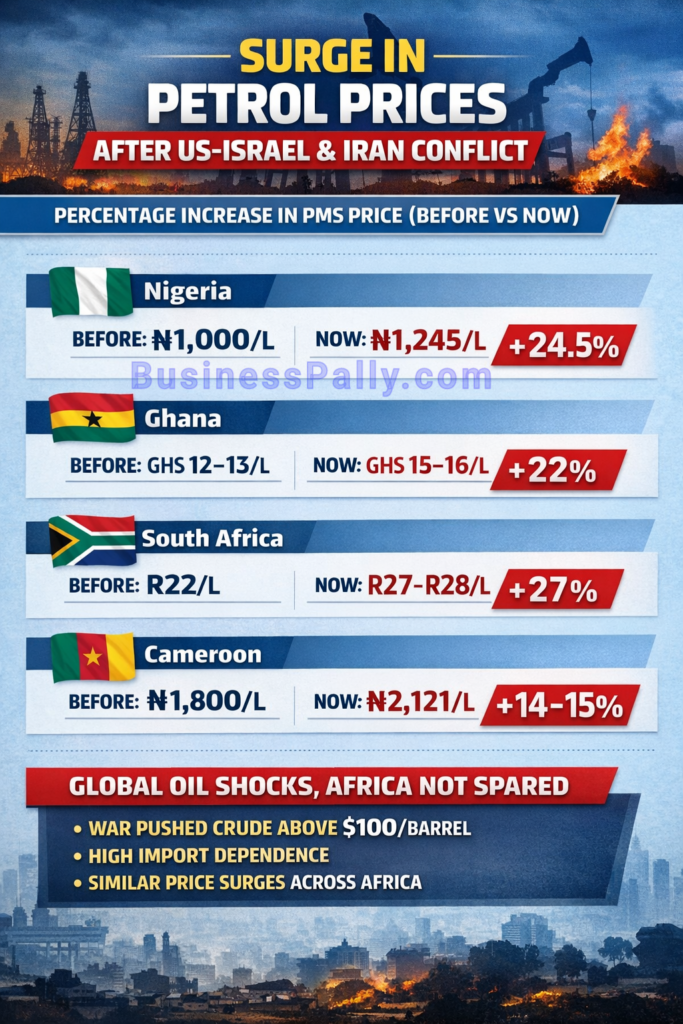
So, what’s responsible for this? Could it be structural inefficiencies or deeper issues like corruption within the oil and gas sector?
Answer
The oil sector is widely regarded as one of the most opaque sectors in Nigeria, where corruption has been deeply entrenched over the years.
Question
You mean the Nigerian oil and gas sector?
Answer
Yes, the Nigerian oil and gas sector has long struggled with transparency.
To date, there are persistent concerns that no comprehensive and fully credible audit of the national oil company has been successfully carried out since independence.
Question
In the last quarter of 2025, the Dangote Group suspended the crude-for-naira deal with NNPC.
Since then, it has increased exports of refined products such as fuel oil, naphtha, and diesel to Europe, West Africa, and the United States.
Nigeria is exporting refined fuel while its citizens struggle with high domestic prices.
So, what exactly led to the suspension of that deal? Why is the refinery now importing crude to supplement local supply? And what is the government doing to address this?
This is a 3-in-1 question.
Answer
The situation reflects the government’s attempt to balance competing interests between private investors like Dangote and international stakeholders.
As a result, policies sometimes appear to favor certain players. The reliance on Dangote Refinery for domestic supply has also led to decisions that consolidate market control, including limiting the role of other marketers.
Question
Headline inflation stood at about 15.06% in February, yet many states are already experiencing inflation above 20%, driven largely by food prices and rising local costs.
If this war persists and global oil prices climb beyond $150 per barrel, the consequences could be devastating for Nigerians.
Do you think the government has any concrete plan to cushion these effects?
Answer
There appears to be limited confidence in the government’s immediate plans to cushion the economic impact.
Political priorities, particularly upcoming elections, may influence the pace and seriousness of policy interventions.
Question
Finally, if you were the President of Nigeria today, what immediate steps would you take to ease the burden of high petrol prices on the masses?
Answer
Nigeria must prioritize achieving full domestic refining capacity, regardless of the cost or effort required.
In the short term, the government should take a more active role in monitoring and regulating fuel prices to prevent excessive profiteering and protect consumers.
Conclusion
Our guest speaker, Mr Olasogba Olakunle, has been on standby for about two hours, responding to our questions on the topic: Petrol Pump Price Hike: War Impact or Government Failure.
Mr Olakunle, it’s good to have you here tonight. I appreciate you for your time.
Once again, I’m Comrade Akinyande Ayomide, media publisher and marketer.
Thanks for coming.
Always welcome, bro.
We now come to the end of tonight’s lecture. Thanks to all for staying tuned!

An entrepreneur, business administrator, investor, and publisher who has spent nearly two decades exploring how emerging tech, the internet, and innovation continue to redefine the way people live, work, and build success.
With a unique blend of insight and experience, BusinessPally won the Corporate Vision Magazine – Global Business Award.
I love sharing lessons, personal stories, and forward-thinking ideas that help entrepreneurs and professionals navigate the changing world of business with confidence and creativity.