Most Nigerians distrust the country’s electoral process, especially the transmission and collation of results.
Despite the adoption of technologies such as BVAS and IReV, there appear to be loopholes in the legal framework governing the electoral process.
In an effort to strengthen the system, the lower chamber of the National Assembly (NASS) has mandated real-time electronic transmission of results, while the upper chamber has provided an alternative for manual transmission should technology fail.
Finally, President Bola Tinubu signed the electoral acts and it was not stated whether the presiding officer should use electronic transmission or manual transmission.
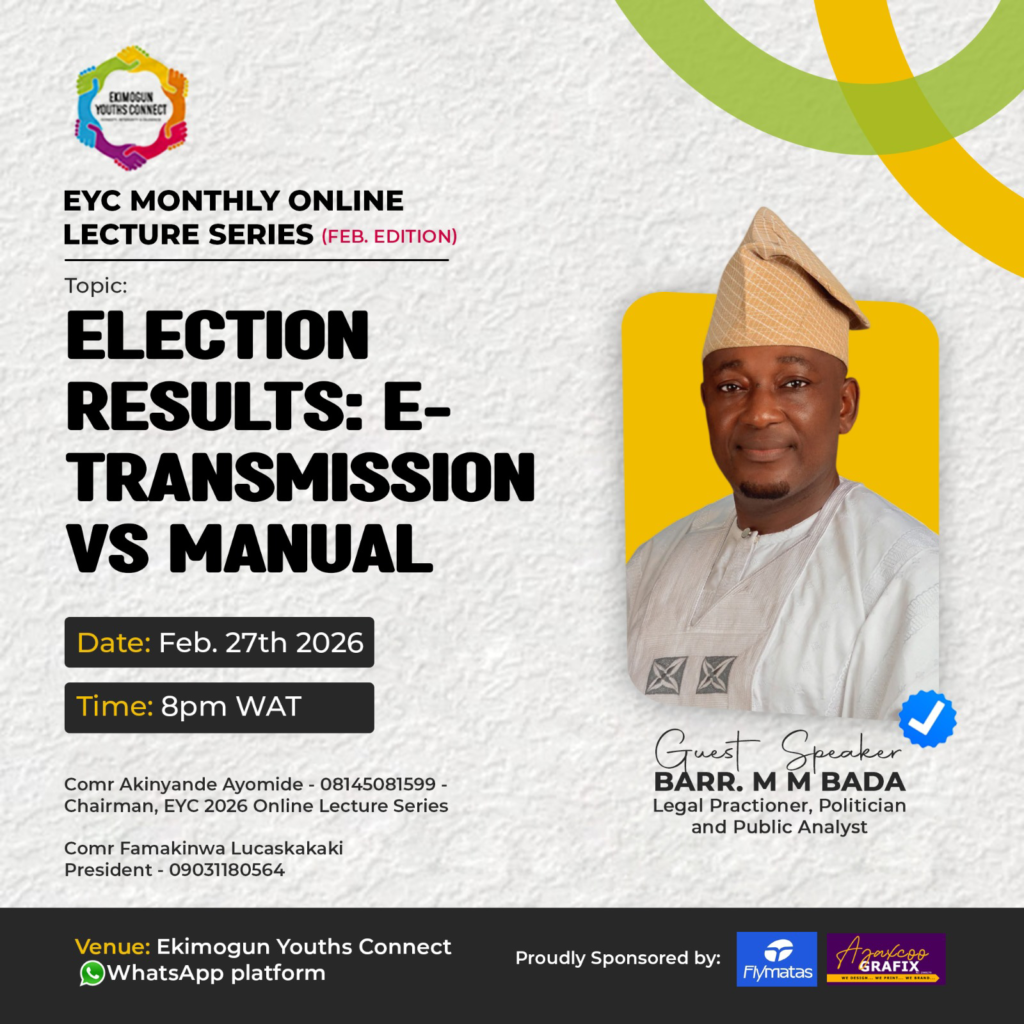
Therefore, the leadership of Ekimogun Youths Connect (EYC) – the youth organization that unifies all youth groups in Ondo, themed their 2nd edition of Monthly Lecture Series towards this issue.
TOPIC: Nigeria Election Results: E-transmission vs Manual
In this edition, Barr. M.M. Bada, a legal practitioner, and public affairs analyst did justice to the burning questions.
Q.1
The proposed reform by the National Assembly Committee on Electoral Matters, Section 60(3), contains three key elements:
- Mandatory electronic transmission of election results
- Explicit reference to the INEC Results Viewing Portal (IReV); and
- Real-time upload of results while collation officers and party agents are present at the polling units.
Section 60(3) was initially rejected outright by the Senate, sparking reactions from civil society organisations before the Senate eventually adopted a modified version of the clause.
Why do you think the Senate rejected this reform in the first place?
Thank you very much for the question.
You will agree with me that the upper chamber, the Senate, is made up of experienced individuals.
When we look at the proposed bill by the House of Representatives, it recommended the immediate adoption of electronic transmission of results.
However, you will also agree that electronic transmission can be manipulated.
There are additional challenges associated with electronic transmission, such as network instability and electricity issues, which could affect its effectiveness.
These are some of the concerns the Senate considered. In its judgment, it proposed that there should be a backup system on which INEC can rely in case electronic transmission fails.
The distrust in Nigeria’s electoral process led many Nigerians to question why the Senate rejected electronic transmission.
However, electronic transmission cannot yet be fully implemented without addressing existing challenges such as electricity supply and network connectivity.
That is why the Senate did not support 100 percent reliance on electronic transmission.
Q.2
The version of Section 60(3) adopted by the Senate provides that results shall be transmitted to IReV and that, in the event of communication failure, Form EC8A (manual transmission) shall serve as the primary source for collation and declaration of results.
However, “communication failure” is not clearly defined, thereby creating ambiguity in the amended clause.
Some senators have reiterated that connectivity in rural areas is limited.
Given the configuration of BVAS, results can be captured and stored without internet connectivity and transmitted automatically once connectivity is restored.
Do you think low connectivity in rural areas justifies retaining manual transmission?
If you examine Section 60 of the Electoral Act recently signed by the President, you will notice that there is no clear provision stating whether the presiding officer must use electronic or manual transmission.
The provision appears ambiguous, as it simply states that the Presiding Officer shall record the results in Form EC8A as specified in Section 60.
First, it is not ideal to amend electoral laws less than a year before a general election. Such amendments should be made at least two years before the election to allow adequate preparation and implementation.
Low connectivity in rural areas should NOT be a sufficient reason to exclude electronic transmission from our electoral laws.
In my view, ICT experts in Nigeria should have advised lawmakers and INEC to develop a reliable system that presiding officers can use to record results.
Such a system could allow results to be entered and verified by the presiding officer, security officials, and party agents.
Where discrepancies arise, manual records could then be used for comparison and correction.
There should be a secure system that receives results in a manner that prevents further alteration.
Low connectivity should NOT be a basis for rejecting electronic transmission.
There are many strategies that can be adopted to combat the falsification of results, which remains a major challenge in our electoral system.
As I have stated, low connectivity in rural areas should NOT be a ground for rejecting electronic transmission.
Q.3
So, you think the risks associated with electronic transmission should be mitigated, since manual collation leaves room for human interference compared to electronic transmission?
The challenges associated with electronic transmission can, in some cases, exceed those of manual transmission.
Electronic systems can also be compromised if not properly secured.
Q.4
Communication failure is the Senate’s primary reason for opposing real-time transmission.
In your view, could this create a loophole for deliberate network sabotage by presiding officers, INEC officials, or politicians, especially since the term is not clearly defined?
Both electronic and manual transmission processes can be manipulated, depending on the integrity and disposition of the individuals handling the results.

Q.5
Let us also consider how election results are transmitted and collated in Ghana and South Africa.
In Ghana, results are transmitted manually from polling units to constituency collation centres and then to regional collation centres before being forwarded to the national collation centre.
In South Africa, votes are counted at polling units and signed by the presiding officer and party agents.
A copy is posted at the polling unit, while results are captured using GPRS-enabled mobile devices or transported to local offices for scanning.
Can we therefore conclude that retaining manual transmission, at least for now, is not necessarily problematic?
It is relatively easy to disrupt network connectivity. Simple devices can interfere with signals within a limited range.
If such interference occurs, electronic transmission may be affected, forcing a return to manual transmission.
We must be honest with ourselves. Addressing the problems affecting Nigeria’s electoral process requires genuine commitment from all stakeholders – lawmakers, politicians, civil servants, security agencies, and citizens alike.
Without that collective resolve, reforms may not achieve their intended impact.
Q.6
As you mentioned, the Electoral Act signed by the President does not clearly state whether the presiding officer must use electronic or manual transmission.
Do you think a presiding officer could deliberately delay transmission, whether electronic or manual?
Do you think this situation could create opportunities for result manipulation?
Or why does South Africa not experience similar controversies as Nigeria?
If a presiding officer is poorly accommodated before an election and depends on politicians for basic needs such as food, questions will naturally arise about independence and impartiality.
In such circumstances, a presiding officer could deliberately delay or frustrate transmission, whether electronic or manual.
Q.7
How do you reconcile the Senate’s position with the repeated assurances by INEC that it has the capacity to deploy technology effectively?
Results can be altered under either system, depending largely on the integrity, belief, and conviction of the presiding officer.
This is why I consistently emphasise the need to build and mentor young people to be patriotic and incorruptible, so that when they occupy positions of responsibility, they cannot be easily influenced.
Q.8
Do you think the Senate should propose a comprehensive cybersecurity framework to strengthen digital transmission instead of limiting its use?
Yes. It is time for lawmakers to enact comprehensive electoral reforms. The “fire brigade” approach to lawmaking must end.
Q.9
Finally, in your opinion, what measures should the National Assembly put in place to ensure that election results are transparent, credible, and widely accepted?
When you attempt to enact strong and effective laws, you may become unpopular with those who benefit from weak ones.
In my view, the process for appointing the INEC Chairman should be reconsidered.
For example, rather than being nominated solely by the President, alternative mechanisms could be explored to ensure greater independence and public confidence.
Secondly, there should be a national conference comprising carefully selected stakeholders to draft comprehensive and enduring electoral laws.
Relying solely on lawmakers who may have political interests may not always produce the most objective reforms.
Conclusion
Thank you once again!
We appreciate your contributions tonight and hope you will join us again when invited.
Dear people of Ondo, we have spent the last hour discussing this important topic: Election Results – Electronic Transmission vs Manual Transmission.
Our guest speaker has been Barrister M.M. Bada, legal practitioner and public affairs analyst.
Of course, I will always be available to answer your call.

An entrepreneur, business administrator, investor, and publisher who has spent nearly two decades exploring how emerging tech, the internet, and innovation continue to redefine the way people live, work, and build success.
With a unique blend of insight and experience, BusinessPally won the Corporate Vision Magazine – Global Business Award.
I love sharing lessons, personal stories, and forward-thinking ideas that help entrepreneurs and professionals navigate the changing world of business with confidence and creativity.