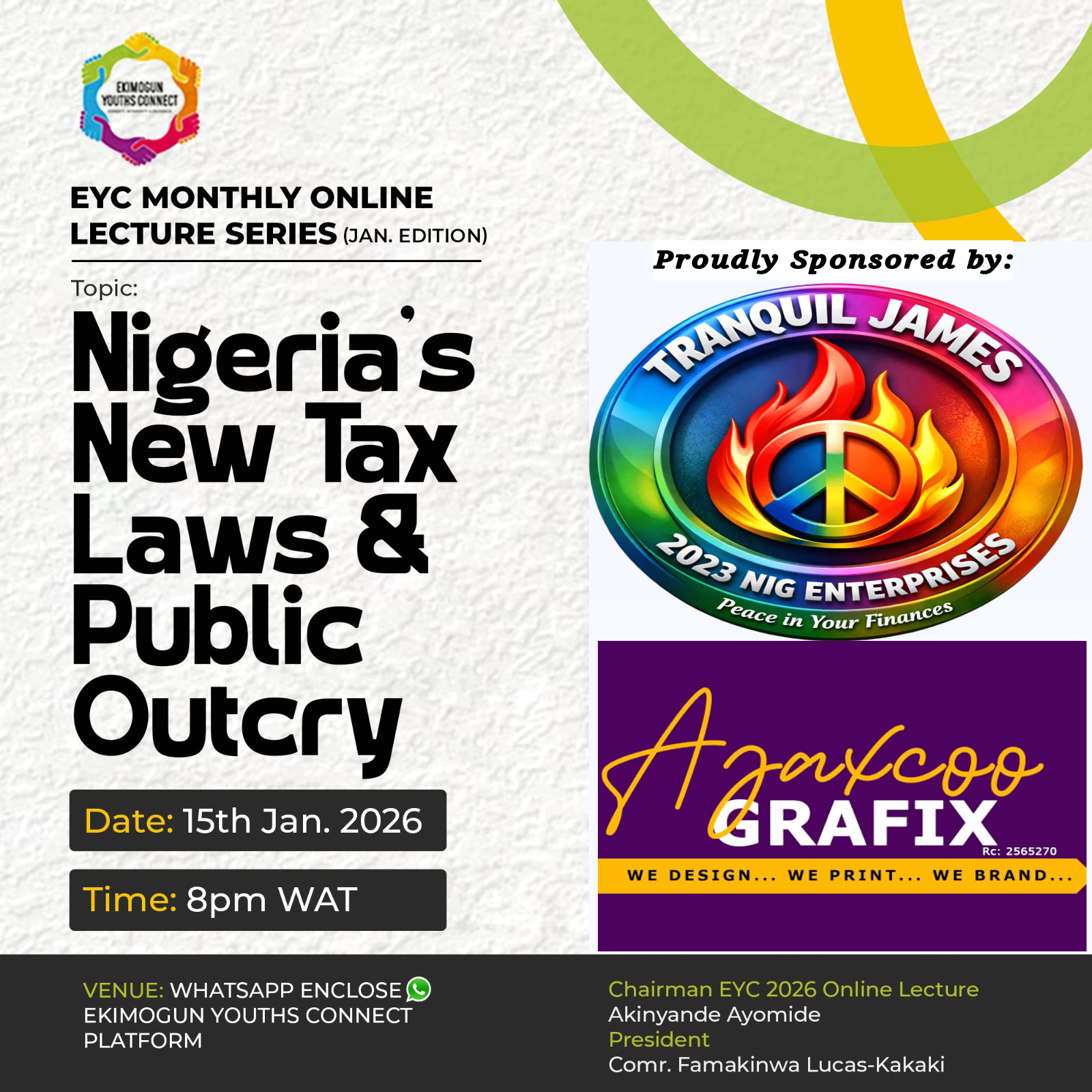
Ekimogun Youths Connect (EYC) has taken the bull by the horns, demystifying the misconception and misperception of Nigeria’s New Tax reforms.
EYC is a nonprofit organization that unites all the sons and daughters of Ekimogun globally.
Under the leadership of Famakinwa Lucaskakaki, the Director, National Orientation Agency (NOA), Ondo State, Mr James Adekunle was invited to dissect and simplify the tax reforms to the understanding of common men.

Many Nigerians have been in panic mode for months, with information circulating on social media that personal bank accounts would be frozen unless owners provide their Tax Identification Number (TIN). Do individuals need a TIN to keep or open a bank account?
NIN and BVN are enough to open and keep bank accounts, so there is no cause for panic at all regarding tax reforms and bank accounts.
Another claim circulating on social media is that people should use the description/note column to state the reason for transfers so that gifts and personal funds are not taxed.
I want to ask: Will transfers and deposits into personal bank accounts be taxed? And how will the tax authority differentiate money for healthcare, education and similar needs from sales transactions?
It is not the money in your bank account that will be taxed, and it is not your daily transactions that will be taxed.
Tax will be based on taxable income, that is, after removing all your inputs or expenditures.
For business owners, you will deduct the cost of running the business, and only the profit left as income will be taxed.
Will churches and mosques begin to pay tax now?
Students, pensioners, and people earning less than #800,000 naira are exempt.
Churches, mosques, and places of worship are also exempted.
If I take a loan from a lender, whether a bank, cooperative society or others, will I pay tax on the money?
Loans taken from cooperatives, banks and other lenders will not be taxed.
It is the company or institution that lends you money that will be taxed on the income they generate from loaning the funds out.
How will the tax authority know the money I earn from others?
It is important to keep proper financial records. As a trader, you should have a book where you write your income and expenditures.
Keeping accurate records of your transactions is important, and the narration on each transaction matters.
Under the new tax law, technology will be deployed. That is why the government is discouraging the use of raw cash and placing withdrawal limits weekly.
When transactions are done electronically, they become easier to track and tax correctly.
You should also differentiate what is taxable from what is not.
If money enters your account that does not come from income – such as a loan or a gift – nobody will tax it.
What if I get overtaxed? What can I do?
Nigerians will now be able to enjoy tax refunds.
If, at the end of a tax period, it is discovered that you have been overtaxed, the excess will be refunded to you.
This is why it is important to keep records, so that if the tax authority assesses you incorrectly, you can compare and confirm excess deductions for a refund.
The good news is that there is an arbitrator who resolves disputes between taxpayers and the tax authority, and their services are largely free.
This is one of the measures under alternative dispute resolution.
As I mentioned earlier, it is easy for anyone to calculate their own tax. Simply keep a record of all income and expenditures.
At the end of the year, you will clearly see what your taxable income is.
What are the new progressive tax bands?
#800,000 naira is the minimum threshold for personal income tax.
After that is the 2.2 million naira band taxed at 15%.
The next is 9 million taxed at 18%.
Then 25 million taxed at 23%.
The next threshold is 50 million, taxed at 25%.
How do I know my taxable income?
Calculating it is not difficult. To make it easier, visit fiscalreforms.ng, where a tax calculator is available.
Do individuals pay tax on remittances or family support coming from abroad?
People in the diaspora who send money for family support, such as to parents or loved ones, will not be taxed because the money was earned abroad and already taxed.
Only income earned abroad while you are living in Nigeria will be taxed.
If I send 10 million naira to someone who is sick, how will the government know the person did not earn it?
Add a narration to transactions sent to support someone in a sick bed. Such funds will not be taxed.
Many Nigerians are poor and cannot keep financial records. Doesn’t this pose a big problem?
Illiteracy is indeed a concern. The tax authority is aware that many petty traders cannot keep detailed records.
Also, many of them will not earn up to #800,000 naira annually after deductibles.
This is why the new tax regime benefits low-income earners – most of them are exempt.
However, people in big business who can earn more than 100 million naira should be financially literate.
If your annual income is below 100 million naira, you are exempt from tax.
Anyone earning above 100 million should either be literate or capable of employing someone to handle record-keeping.
Is this tax reform a blessing or a curse for the common man?
It is a blessing because the common man is unlikely to pay tax. People earning less than one million naira yearly will not pay.
For the middle class, after deducting allowable expenses, the tax payable will be far less than before.
I calculated mine and compared it with previous years, and the difference is clear.
The present system is progressive – as income increases, the tax rate increases. Therefore, the rich pay more and the poor pay less.
This is a complete departure from the past.
Previously, taxation was regressive – poor people paid more of their meagre income while the rich paid less proportionally.
So today, the poor genuinely pay less. This tax system targets the wealthy, which is why most low-income earners will not pay anything.
What has changed in the revenue-sharing formula among federal, state, and local governments?
Most taxes now go to state and local governments. This makes it necessary for citizens to hold them accountable.
States are allowed to domesticate the tax law and develop formats that align with the federal structure.
Fortunately, many states have adopted the new system. Now citizens can demand transparency.
Many local governments do not even have websites for financial disclosures.
Such local governments should be encouraged to create websites and publish records so citizens can see how tax money is being spent.
How will capital gains and investment income be taxed, especially when investors reinvest instead of withdrawing into their bank accounts?
There will be no tax if the sale of shares is not more than 150 million naira and the profit is under 10 million naira.
Only a small number of wealthy Nigerians fall into this category, so the average person should not worry about this reform.
Under the new tax reforms, digital assets such as crypto, NFTs, and online income from influencers and remote workers are taxable. What mechanisms ensure accurate calculation and deduction?
The mechanisms for calculation and deduction rest with the tax authority.
Your role is to file your returns before the tax authorities contact you.
Technology will be deployed. That is why cash use is being discouraged and withdrawal limits are being enforced.
Electronic transactions make it easier to track and apply the correct tax.
Does income tax go to my state of origin or the state where I reside?
Tax applies where you live, do business, and earn your income.
If I have a company and a shop, do I pay trader levies plus tax under the new law? Also, many small businesses pay double tax to their local government and unions. Where does the new law stand on this?
The tax reforms are designed to curb multiple taxation.
We want to end situations where the federal, state and local governments all tax the same person.
All taxes are now harmonised into one system.
What happens if eligible individuals or businesses fail to file or pay under the new system?
Individuals and businesses are required to file tax returns. It is better to comply rather than wait for the tax authority to pursue you. This is why record-keeping is important.
Tax offices exist at the local, state and online levels. Use any of these platforms to file returns.
Previously, many people evaded taxes because the process was manual and the rich often bribed their way through. The government lost revenue.
Now, everyone who ought to pay will be compelled to pay.
There will be little or no room for tax default, and the tax authority can take action – including court processes.
Will money transferred to organisations like cooperatives, churches and nonprofits such as Ekimogun Youths Connect be taxed?
Organisations should keep records of their members. Such records must be available to the executives, who will act as arbitrators between individuals and the tax office.
The government has increased VAT again. Isn’t this too much money taken from us?
The 7.5% VAT is not charged on the full transaction amount but on service charges on transactions.
Conclusion
This reform aligns with the economic transformation of the country and has received commendations from world leaders.
Without the reforms initiated by President Tinubu, the dollar-to-naira rate and petroleum prices would not have stabilised.

An entrepreneur, business administrator, investor, and publisher who has spent nearly two decades exploring how emerging tech, the internet, and innovation continue to redefine the way people live, work, and build success.
With a unique blend of insight and experience, BusinessPally won the Corporate Vision Magazine – Global Business Award.
I love sharing lessons, personal stories, and forward-thinking ideas that help entrepreneurs and professionals navigate the changing world of business with confidence and creativity.