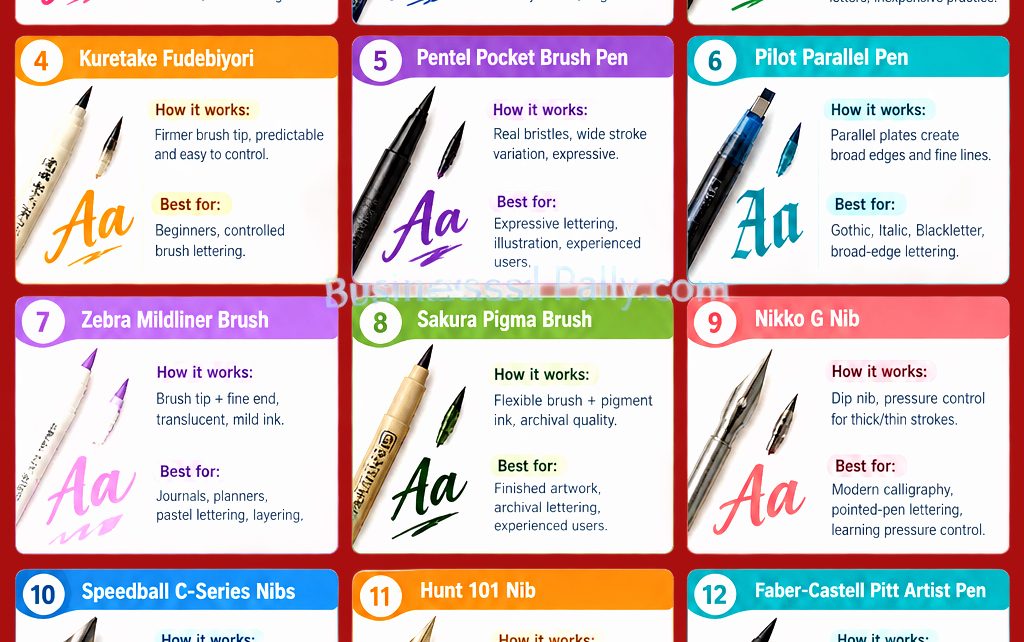
Tombow Dual Brush Pen
This is one of my best and most complete hand-lettering tools, considering its two ends.
It has a nylon brush end which is flexible enough to allow you to vary pressure to create thin upstrokes and broad downstrokes, while the opposite fine tip helps with outlines, small details and corrections.
In the pack, you also have the water-based ink that blends cleanly.
Most brushes get blunt over time due to repeated use, but the Tombow brush pen maintains a good point, and colour quality, making it durable for regular use.
Another thing I like about it is the fact that I can do much with one pen, even as a beginner calligrapher, it’s going to help with colourful lettering, good headers and letterforms of any size.
The downside with this tool is that the large brush is difficult to use to draw small letters, and the fibre tip can wear if you repeatedly use it on rough papers.
But honestly, I think this is also applicable to many other brushes.
Tombow Fudenosuke
Tombow brush also ranks second in my list, and this time, the Fudenosuke brush.
This is perfectly designed for writing small letters. The brush has a firmer tip which responds to pressure without spreading as dramatically as the Dual Brush Pen.
This brush is good for beginners learning pressure changes before they are able to move to softer brushes.
My advice is that you get both the hard and soft versions so you get used to controlled and more flexible tips, which will help improve your lettering skills.
Pentel Sign Pen Brush
Think of a cheap brush that does a good job, then the Pentel Sign is one.
One thing I like about it is the flexible tip that responds well when you apply small pressure, and the ink flows out smoothly.
Not only is the tip sensitive to pressure, but it also does not wear easily, which also saves you costs in the long run.
Pental sign brush and Tombow small brush pens are my recommendations for beginners.
I particularly like this pen when I want brush-lettered words without the larger footprint of a Dual Brush Pen.
Kuretake Fudebiyori
Though the Fudebiyori brush tip is firm, it’s easy to use. You can even find it easier to control than some softer brush tips.
This makes it a good option for beginners, and even pro would love it.
It’s a reliable brush that’s as good as Tombow Fudenosuke and Pentel Sign Brush.
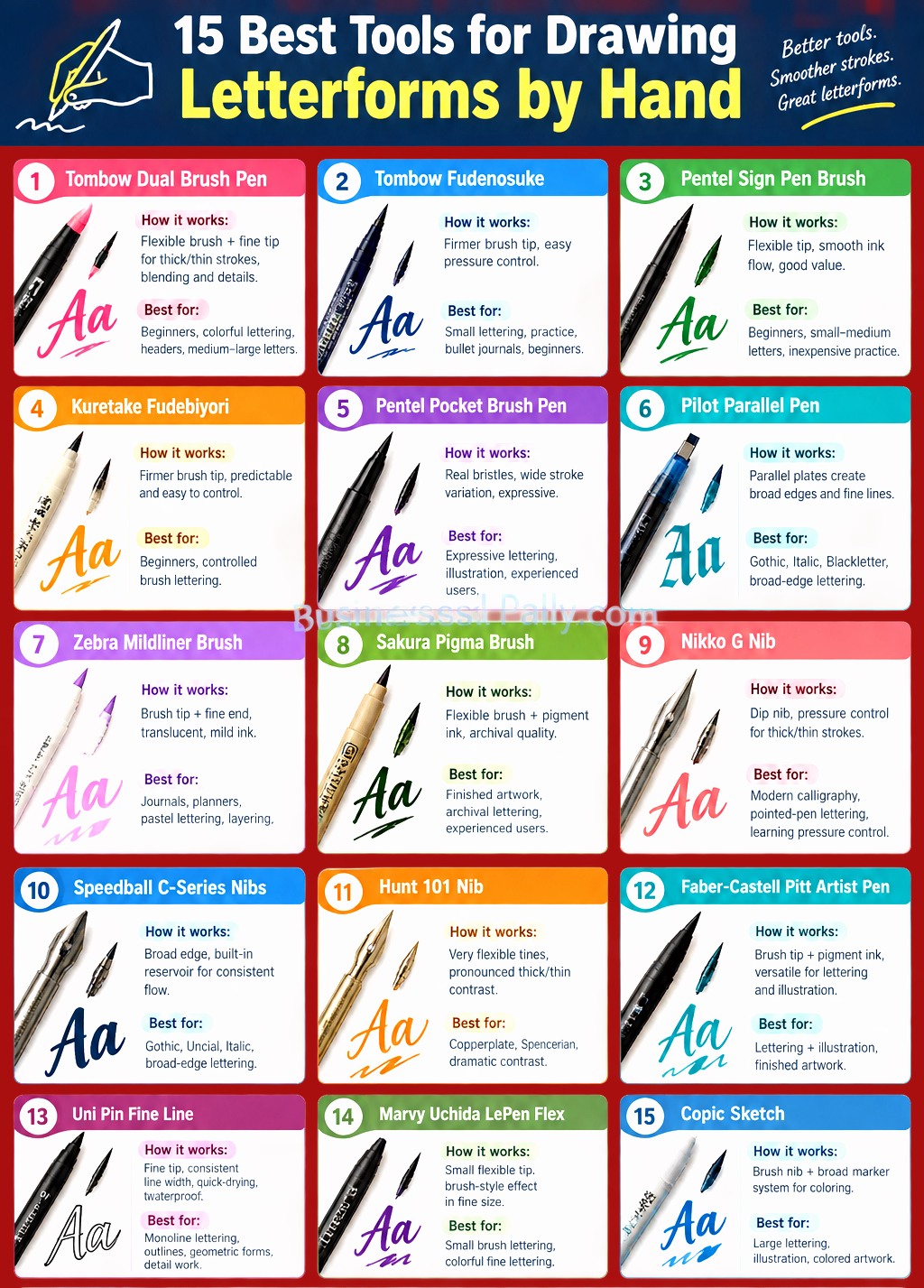
Pentel Pocket Brush Pen
Whenever I want my letterforms to have more variation and movement, I consider a Pentel pocket brush pen.
This is not a regular felt brush marker. It uses actual bristles, so pressure and angle produce a much wider range of strokes.
It is a powerful tool that is less technical, and you can produce nice letterforms with little hand movement and pressure.
That flexibility is its selling point, but it requires more practice to get the desired results.
It’s not what a beginner can handle properly, but once he has good control, it can produce lettering that feels much less mechanically uniform.
Pilot Parallel Pen
This brush pen is different from most tools in this list. Its nib has two parallel metal plates which allow you to create broad, crisp strokes with the flat edge and much finer lines using the narrow edge or corner.
It comes in several widths from 1.5 to 6 mm.
I particularly like it for Gothic, Blackletter, Italic and other structured forms, and the ease with which to experiment with
The only issue I have with it is the inconsistent ink flow sometimes when I write with larger nibs. Also, the ink is not waterproof.
Zebra Mildliner Brush
The Mildliner Brush works differently from regular tools like Tombows.
Though it has a firm brush tip, it is easier to use than Tombow’s similar brush tip
It has translucent, mild-colored ink that makes your lettering sit comfortably inside a journal or planner without heavy bleed-through.
It produces thick and thin strokes while the fine end gives consistent lines.
Sakura Pigma Brush
Sakura has different brush types, but the Sakura Pigma Brush is a powerful tool in lettering since it combines the flexible brush format with its pigment-based Pigma ink.
In my view, this makes more sense when the finished lettering needs to remain crisp rather than simply looking good during practice.
You can rarely have ghosting or smudging issues with it, and the ink quality is good.
Nikko G Nib
This is a dip-pen nib rather than a self-contained marker. Simply mount it in a holder, load the ink, and start writing.
It is used mostly by beginners because it is durable and doesn’t flex excessively.
Though not every person finds it easy to use, some complained of its stiffness and its sharp point catching on paper.
For me, it’s relatively a good start for learners, especially when you use the right paper, and your writing pressure is good.
Speedball C-Series Nibs
The Speedball C nibs give me a very different experience from a brush pen.
I dip the nib into ink and use its broad edge to construct consistent strokes for Italic, Gothic, Uncial and related lettering styles.
The built-in reservoir is particularly useful because it can hold enough ink for several letters before another dip.
Hunt 101 Nib
The Hunt 101 is very flexible and sharp, more than the Nikko G.
When I apply pressure, the tines spread considerably, giving me pronounced thick downstrokes; releasing pressure brings them back together for fine hairlines.
That makes it excellent for Copperplate and Spencerian-style lettering.
It is not only good for calligraphy, but also for detailed drawing. The only issue with it is that sometimes, it snags rough paper.
Faber-Castell Pitt Artist Pen Brush
The Pitt Artist Pen is useful when you want the convenience of a marker but don’t want the extremely soft behaviour of a large brush pen.
Its brush tip allows you to build variable-width letterforms while its pigment ink makes it better suited to finished illustrations.
I would place it below the more specialised lettering pens because it isn’t as purpose-built for brush lettering.
Its strength is versatility. You can move from lettering into illustration, outlines and detail work without changing tools.
Uni Pin Fine Line
The Uni Pin isn’t a brush pen, and that’s precisely why I included it.
When I draw block letters, geometric forms, outlines or detailed lettering, I often want predictable line width rather than pressure-sensitive variation.
The pigment ink produces bold, consistent lines, dries quickly and resists water, fading and rubbing.
Marvy Uchida LePen Flex
LePen Flex fills an interesting gap between a conventional fineliner and a larger brush marker.
The smaller flexible tip lets you draw brush-style letters without having to make them large.
If you find larger brush pens too thick, you can move toward LePen Flex, Pentel Sign Brush or fine Fudenosuke-type pens.
Copic Sketch
Copic Sketch makes sense when lettering is only part of the artwork. Its brush nib gives variable strokes, while the marker’s broader system makes it useful for colouring and illustration around the letterforms.
I wouldn’t choose it over a Fudenosuke or Pentel Sign Brush purely for learning lettering.
You may find the brush tips too broad for achieving a strong thin-to-thick contrast in small writing but for large lettering incorporated into illustrations, it becomes much more useful.

An entrepreneur, business administrator, investor, and publisher who has spent nearly two decades exploring how emerging tech, the internet, and innovation continue to redefine the way people live, work, and build success.
With a unique blend of insight and experience, BusinessPally won the Corporate Vision Magazine – Global Business Award.
I love sharing lessons, personal stories, and forward-thinking ideas that help entrepreneurs and professionals navigate the changing world of business with confidence and creativity.