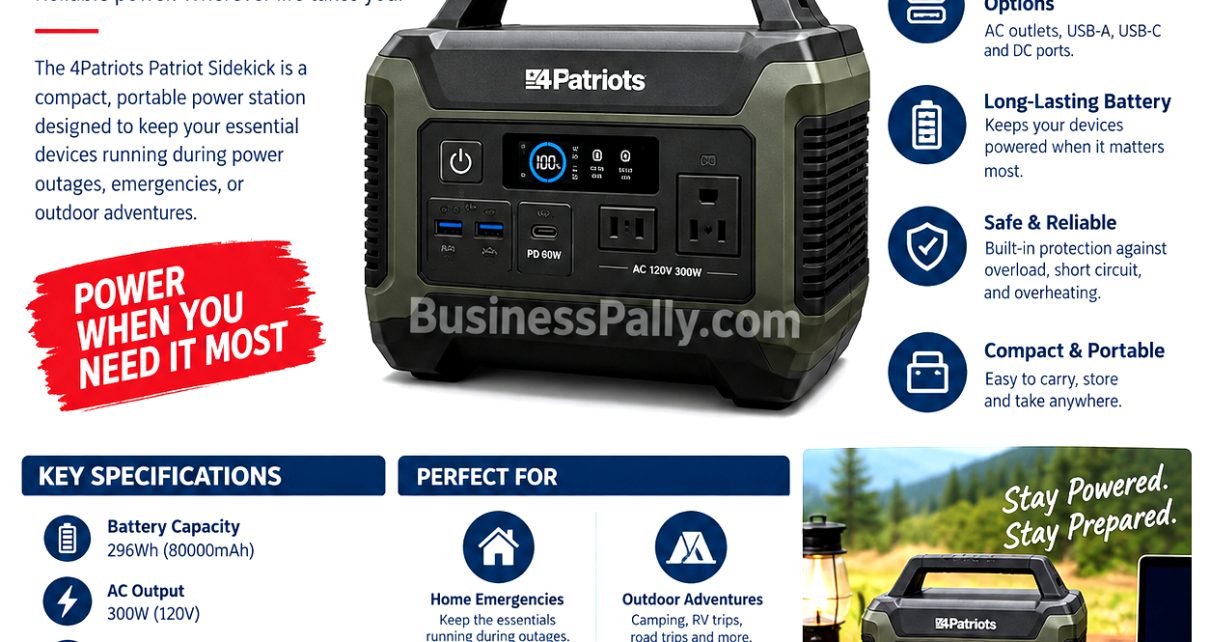
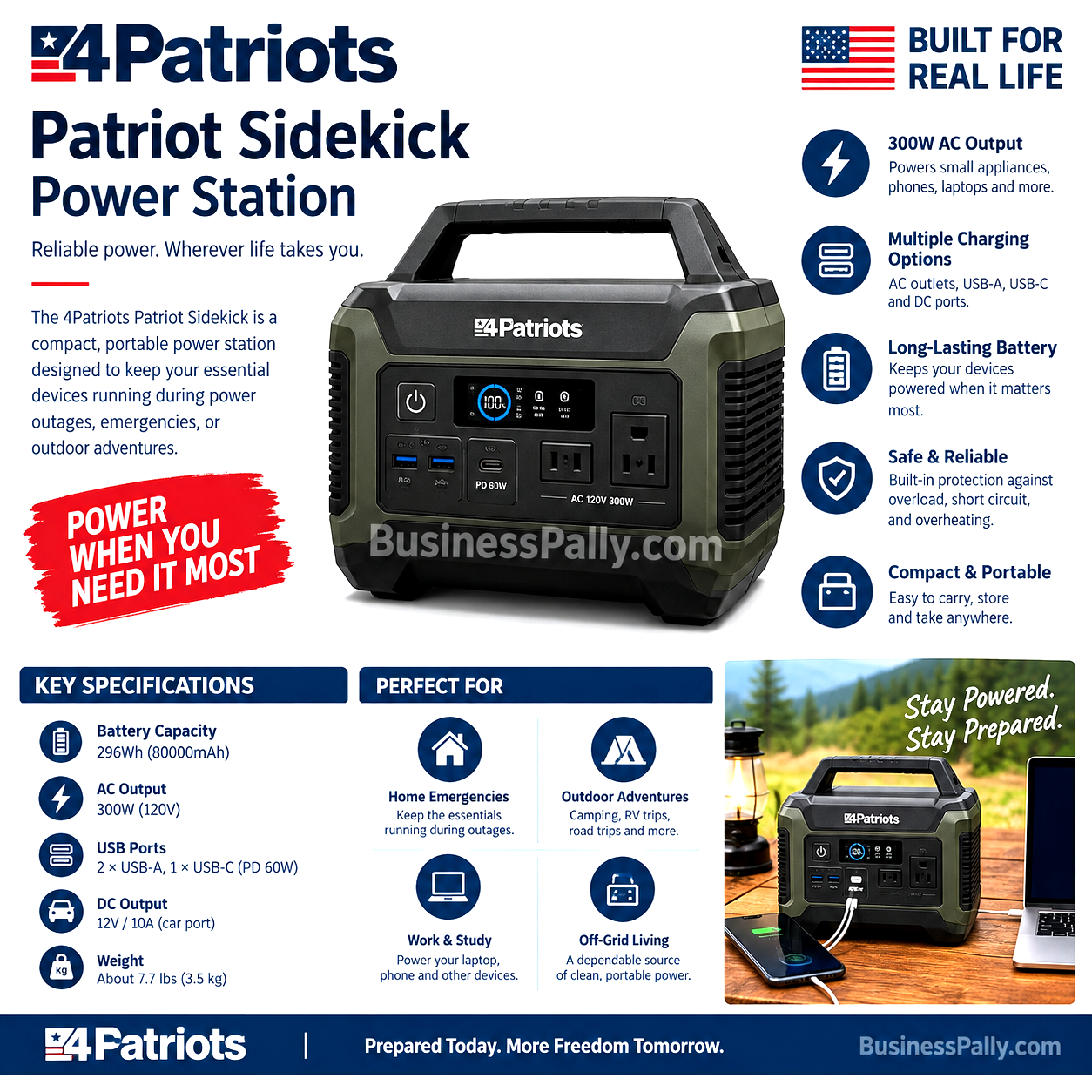
If you’re looking for a portable power station to use in camps, when out of the city or during short power outages, the 4Patriots Patriot Power Sidekick is worth considering.
It has a 299Wh lithium iron phosphate (LiFePO4) battery that stores electrical and solar energy and supplies it to your devices through AC, USB, and 12V outputs.
It comes with a 40W folding solar panel and weighs about 8.5 pounds; compact, and designed for small to medium electronic loads.
What’s the Battery Capacity and Power Output like?
It uses a LiFePO4 battery which offers long cycle life and good thermal stability compared with older lithium-ion batteries.
It has a 299Wh battery capacity which means it stores up to 299 watt-hours of energy.
It has roughly 2,000 charge cycles, though the actual service life depends on usage, the way you charge, the temperature at which it works, discharge depth and storage conditions.
The 299Wh cap is just a specification, 299 watts per hour may not always be available at every output.
For example, when you use the AC inverter, there will be conversion losses, so the energy available to an AC appliance will be lower than the battery’s nominal capacity.
I would generally plug in devices that consume an average of 50Wh per hour to this power station.
Electronics such as mobile phones, computers, radios, TVs, small fans, LED lights, and other low-energy-consuming gadgets are most suitable for it.
The AC inverter delivers 300W continuously, with up to 360W of peak power.
This limit creates a firm boundary for heavy appliances that require too much power.
I would generally not use my microwave, dryers, air conditioner, electric kettles, coffee makers, etc with it because they have high startup surge which can exceed the inverter’s capability even when its normal running wattage appears acceptable.
Charging Sidekick Solar Generator
You can charge Sidekick solar generators with household AC power, solar power and through compatible DC charging.
However, AC charging is preferable since it’s the fastest method. It takes between 5 and 6 hours to fully charge.
The folding solar panel that comes with it allows it to recharge away from the electrical grid.
If it’s solar charging, it can take 8 to 10 hours for a full solar recharge depending on sunlight, panel placement, or weather.
Thanks to its MPPT solar charging, which helps it extract solar energy from the panel more efficiently than basic solar charge controllers.
The 40W Solar Panel
To make your power station charge faster, you have to position it in direct sunlight, without any obstruction and connect it to the Sidekick’s solar input.
However, solar charging shouldn’t be your first option so the battery can last longer.
A 40W solar panel has less capacity to continuously supply a 40W battery. Also, its actual output drops with low sunlight intensity, temperature, and shading.
The solar panel therefore works best as an alternative, especially during daylight with high sunlight intensity rather than as a source of continuous high-power electricity.
Again, the solar cable is short, which can limit panel placement in sunlight, in the right direction and angle.
AC, USB and 12V Connections
The Sidekick provides multiple output types so that you can plug in different devices without needing adapters.
It has the AC section that uses two 110V pure-sine-wave outlets.
Pure-sine-wave power is suitable for sensitive electronic equipment and is closer to the electrical waveform supplied by conventional household outlets.
It also has USB-A and USB-C charging, including USB-C Power Delivery of up to 60W on the applicable output.
This is useful for modern smartphones, laptops and other USB-C devices.
Sidekick also has 12V DC outputs, including an automotive-style 12V connection.
These are useful for camping equipment, vehicle accessories, lights and other DC devices.
It has an LCD that tells you battery and power usage, when the device consumes more power than it can handle, etc.
What the Sidekick Can Power
Like I’ve mentioned earlier, don’t try to overload the power bank with devices that consume high power.
According to 4Patriots, Sidekick can run a 5W device for 60 hours, so you can do the maths for other devices.
While this specification is good, the actual runtime depends on your device’s real power consumption, whether it cycles on and off, the output being used, battery condition and conversion losses.
To estimate the runtime of any equipment properly, divide the Sidekick battery’s usable watt-hours by the device’s power consumption, then give room for conversion losses.
For example, a 20W load cannot simply be expected to run for 299 ÷ 20 = 14.95. It means all 299Wh can be used by the device which is not possible.
Therefore, expect such a device to have a runtime of 13 to 14 hours.
Some heating and cooling devices such as microwaves, dryers, AC, and electric kettles experience more losses because the battery’s DC electricity has to pass through the inverter before becoming AC power.
These losses are one of the reasons I advised against using them with your power station so my low-power USB and DC equipment can efficiently use the stored energy rather than an equivalent AC load.
Operating Temperature and Storage
Temperature affects lithium battery performance and charging.
4Patriots recommended charging it at 50-86°F (10-30°C) for optimal charging performance. Extreme temperatures can reduce charging and battery efficiency.
Also, don’t keep it where there’s excessive heat, moisture and prolonged direct sunlight.

An entrepreneur, business administrator, investor, and publisher who has spent nearly two decades exploring how emerging tech, the internet, and innovation continue to redefine the way people live, work, and build success.
With a unique blend of insight and experience, BusinessPally won the Corporate Vision Magazine – Global Business Award.
I love sharing lessons, personal stories, and forward-thinking ideas that help entrepreneurs and professionals navigate the changing world of business with confidence and creativity.